Thursday, August 1, 2019

LG V40 ThinQ Android Pie update rolling out in India

LG has already rolled out Android Pie for the V40 ThinQ in the US, Europe, and South Korea. Now it's time for the Indian units to get a taste of the latest version of Android. In addition to bringing the Android Pie niceties to the V40 ThinQ, the new firmware also comes with features like YouTube Live, Penta shot, Cine shot, Part Slo-mo, and Dual App. Besides, it also bumps up the Android security patch level on the smartphone to July 1, 2019. LG V40 ThinQ Android Pie update The Android Pie update, sporting build number PKQ1.190202.001 and weighing 1.5GB in size, is rolling out...


from GSMArena.com - Latest articles https://ift.tt/2YrdL21

Samsung Galaxy Note10 devices in the US might come with Exynos chipsets

For several years now, Samsung has offered its major flagship models in two variants. Each using either the latest Qualcomm processor, or the latest Samsung-made Exynos chipset. However, this is about to change. This update comes to us from @evleaks on Twitter. The leakster's track record is quite good in accuracy when it comes to leaks and he reports we may see Exynos chipsets on Galaxy Note10 models in the US, except for Verizon's. According to @evleaks, Samsung is only going to use Qualcomm chipsets on Verizon variants of the Galaxy Note10 - the Snapdragon 855 to be exact....


from GSMArena.com - Latest articles https://ift.tt/2yuK5Sb

Hobbs and Shaw Out Now in India in English, Hindi, Tamil, and Telugu

Fast and Furious: Hobbs and Shaw is out now in cinemas across India in English, Hindi, Tamil, and Telugu. Dwayne Johnson and Jason Statham star in the lead.

from NDTV Gadgets - Latest https://ift.tt/2KbtXvy

Xiaomi will announce a new gamepad for the Redmi K20

On Friday at the China Joy Expo, China's largest gaming and digital entertainment exhibition is kicking off through this weekend. Xiaomi is expected to be present at the expo and is expected to make a couple of new product announcements. Xiaomi's official Weibo account just revealed that it is going to announce a new gaming product. Xiaomi published a poster teasing a new announcement for the recently released Redmi K20. The company is expected to announce a gaming laptop, but in addition, it might be finally releasing the game controller accessory that was initially announced...


from GSMArena.com - Latest articles https://ift.tt/2GFiW36

Realme X, Realme 3i to Go on Sale in India Today via Flipkart, Realme.com

Realme X and Realme 3i will go on sale once again today. Realme X price in India starts at Rs. 16,999, while Realme 3i price starts at Rs. 7,999.

from NDTV Gadgets - Latest https://ift.tt/2MzKN90

Next-gen Mahindra Thar: What to expect

Mahindra has already begun work on the next-gen Mahindra Thar, which is expected to make its public debut at the 2020 Auto Expo. The new Thar is going to be a heavily reworked SUV, as it will sport several mechanical and cosmetic changes over the current-generation off-roader. With the new Thar’s reveal a few months away, we have compiled a list of five important things to know about the next-gen SUV.

New engines

Mahindra will equip the next-gen Thar with a BS6-compliant 2.2-litre, four-cylinder, turbo-diesel engine expected to produce 140hp and 300Nm of torque – a substantial increase over the current SUV’s 105hp put out by the 2.5-litre diesel unit. There are also talks that Mahindra, for the first time since the Thar went on sale, could offer the SUV with a petrol engine. According to speculation, the petrol unit will be the same 2.2-litre engine that does duty on the XUV500.

New platform

The all-new Thar will employ Mahindra’s third-gen chassis – the same chassis used by models like the Scorpio and the TUV300. Along with the new chassis, the SUV will also feature wider front tracks than the current model and a revised front suspension with an independent rear suspension. The new chassis will reduce the off-roader’s wheel-articulation ability by around 10 percent; but will, however, improve its road manners. Mahindra’s engineers are working to overcome the wheel-articulation limitation, though. The next-gen Thar will also see an increase in all its dimensions due to this new chassis.

Improved Safety

All variants of the next-gen Thar will get with ABS with EBS, dual front airbags, a seat-belt reminder and a speed-alert system as standard, due to the new safety laws that made it mandatory for all vehicles to get these, effective from April 1, 2019. In addition to this, the new Thar will also be compliant with the crash-test norms that will come into effect on October 1, 2019. This all translates to the new Thar being a much safer vehicle overall, when compared to the current generation of the off-roader.

All-new interiors

The interiors of the new Thar will be completely redesigned when compared to the current SUV. On the inside, the new Thar will feature a more comfort-oriented layout, with new bucket seats up front, forward-facing seats at the rear (not seen in the spy shot) and either a touchscreen infotainment or a 2-DIN music system built right in the middle of the dash (the touchscreen is something the current Thar lacks). The SUV will also get a new instrument cluster and a steering wheel with media controls. Also, due to the new Thar’s larger dimensions, the interior space is also expected to increase, improving usability and practicality.

New styling

The second-gen Thar will get a ground-up new design which will include new body panels, front and rear bumpers, an all-new soft-top, as well as a hard-top option. The off-roader will sport a muscular design, partially attributed to the prominently flared wheel arches. The new Thar will also sport a new front end that is compliant with the pedestrian safety norms due to come into effect from August 2020.

Also see:

Click here for all Mahindra models, prices, reviews, images, videos and more.

Click here for Mahindra Thar, prices, reviews, images, videos and more.


from Autocar India - Cars https://ift.tt/2ZrenB0

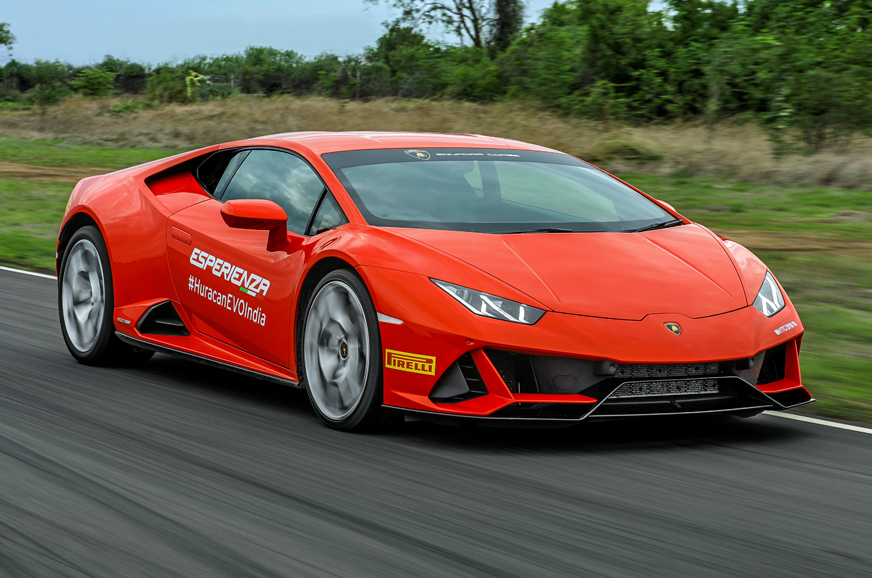
Review: Lamborghini Huracan Evo review, track drive

What is it?

Yes, it’s only a mid-life update, and, yes, it’s got the expected nip and tuck. But this is a supercar and a Lamborghini no less, so a facelift in this part of the world is a proper evolution. Welcome to the Huracan Evo.

Improved aero, a more powerful engine borrowed from the Huracan Performante, a new and intuitive electronic brain and lots of chassis updates including rear-wheel steering. Oh, and yes, this being the digital age and all, there’s a touchscreen with your usual connectivity bits thrown in too, you know, for when you’re just trotting around town. But again, this is a Lambo, so the screen here also has a cool telemetry display for fine-tuning your track day driving and it’s got loads of data from the car's multiple sensors.


From the outside, the keen-eyed will notice the new front bumpers larger air intakes, the newly designed alloys, new side air intakes and the fact that the exhaust pipes have been moved higher up with the number plate placed between them. What will be missed is that all this aero tweaking has also been done to the underbody, and the result is improved downforce and aero efficiency that’s five times more than the first Huracan. 

What’s it like to drive?

We do have a great F1 track in Noida but instead, Lamborghini opted for the smaller and tighter Madras Motor Race Track in Chennai. I’m pretty sure this to highlight the Evo’s new chassis control system – the Lamborghini Dinamica Veicolo Integrata (LDVI). After all, the naturally aspirated V10 doesn’t have to anything to prove; the 5.2-litre unit is from the mighty Performante, complete with titanium intake valves and a lightweight exhaust system, and it brings 640 naturally aspirated horses. The unit propels the Evo from 0-100kph in a mere 2.9sec, pushes it to a top speed of over 325kph and it barks and screams as it goes along. And keeping pace with the rapidly rising tacho is the dual-clutch gearbox which shifts quickly, propelling you forward with ease. It’s all simply magical. 


Now the chassis, on the other hand, does have a point to prove. The earlier Huracan was a bit of a bull and needed quite the hand to tame it, with the Evo, however, Lamborghini is trying to make the limits of performance easier to access. The company says that with LDVI, the car not only reacts quickly to driver input but can also pre-empt certain driver behaviour and adjust accordingly. Does it work? Yes.

Our pace car is a Lambo Urus and it is driven by the company's resident racer Armaan Ebrahim. Both he and the Urus are extremely capable of a good turn of speed, and while he didn't go hell for leather, he indulged us with some pretty decent pace. On the handful of laps we had, the Evo felt fast and nimble, darting from corner to corner with ease. The turn-in is nice and sharp and the tight confines of the MMRT aren’t a bother with both Sport and Corsa (Track) mode neatly balancing the chassis and keeping things very predictable. Of course, also playing an equally big part here is the rear-wheel steering system and the torque vectoring.


'Corsa' is a full track mode with manual shifting, while Sport keeps the gearbox in auto and still allows you a fair degree of slip before the electronics step in to tidy things up. Pushing hard in a bid to keep up, I get the tail out, and what’s nice is that the system comes in quite unobtrusively. LDVI does a really fantastic job of letting you drive this car hard, and just how good is amplified on our second stint when I mistakenly put the car in Strada (Street) mode and I’m all over the place, losing pace to the cars ahead rapidly. The handling is all soft, there’s plenty of roll and soon I’m four to five corners behind the rest. And, of course, the powertrain is not responsive either. Is there something amiss with this particular car or is Armaan pushing harder? Once I realise my error and am done kicking myself, I can only doff my hat to the LDVI’s influence on the Evo’s track behaviour; the difference between Strada and the other modes is quite vast. As for the street, we didn’t drive it there, but judging by the extent of the body roll and softness in 'Strada', it only bodes well for a very useable car for everyday roads too.


So does all of this electronic wizardry take away that absolutely raw, will-kill-you-if-you-misbehave supercar performance? Technically, yes. It’s a lot more sterile an environment than before, but make no mistake, you will be punished for something stupid (like I was), and being able to reach the limits of its performance is something I feel most will happily welcome.

Should I buy one?

Priced at Rs 3.43 crore (ex-showroom), the Huracan Evo costs just about Rs 30 lakh over its predecessor, which if you gather it all in, comes off as a pretty good buy. Yes, there will be a few who may not like the extent of all the electronic aids but there are far more who probably will.  

Like the raging bull adorning its bodywork, Lamborghinis have not always been easy to drive or live with and extracting fine footwork on a racetrack needs some really fancy footwork from behind the wheel as well – the likes of which F1 greats deliver.


Of course, the Huracan Evo is still typically Lambo with its in-your-face styling and there’s all the foot-stomping, mad-charging performance from the engine, along with all the howling and screaming too. But with the new-found chassis balance and, dare I say it, finesse, it’s now far easier to exploit around a track. So in the Huracan Evo then, the raging bull has learned to dance.

Click here for Lamborghini Huracan prices, reviews, images, videos and more

Click here for Lamborghini India models, prices, reviews, images, videos and more


from Autocar India - Cars https://ift.tt/31bXEC9