Tuesday, September 1, 2020

Kia Sonet launch on September 18

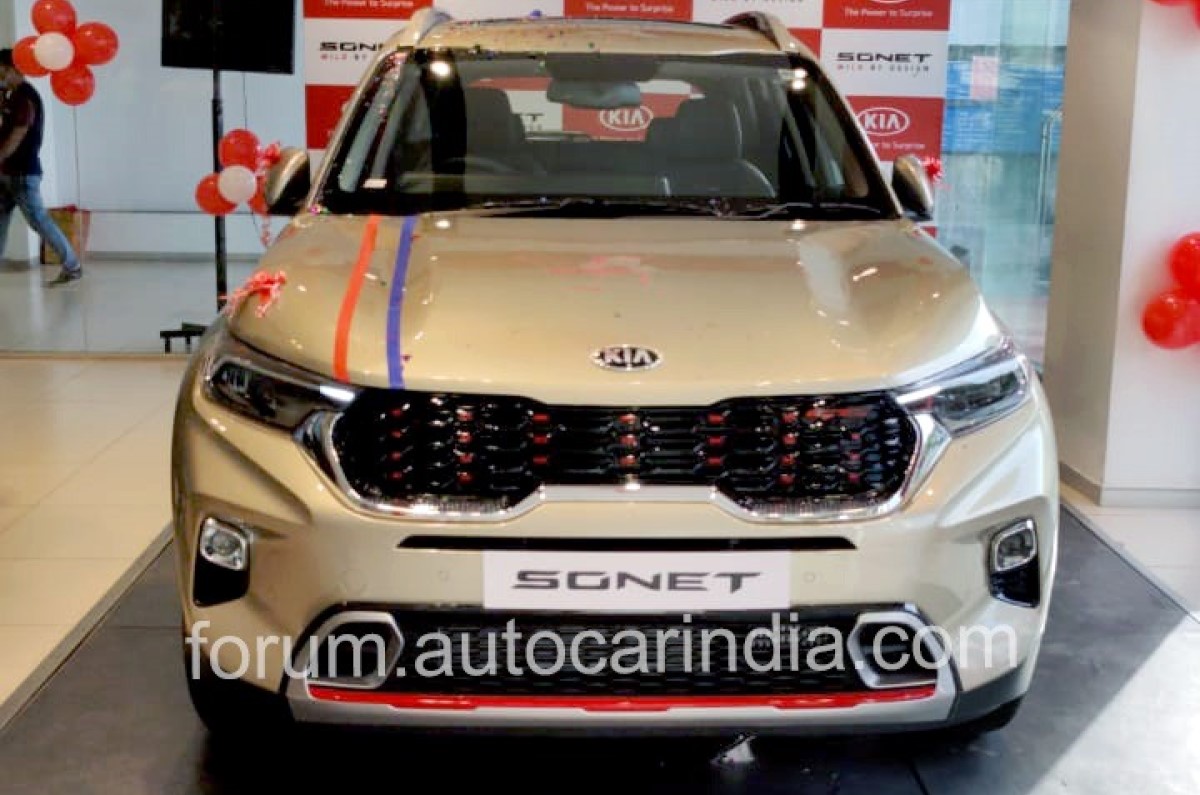
The Kia Sonet is all set to be launched in India this month – on September 18. We recently also got our hands on the Kia Sonet’s technical specifications, which showed some differences compared to its cousin – the Hyundai Venue.

  • Engine options are a 1.2 petrol, 1.0 turbo-petrol and 1.5 turbo-diesel.
  • 1.0-litre engine will come with an iMT clutch-less manual gearbox.
  • Between the Tech and GT Lines, the Kia Sonet will have 6 trims.

What engines and gearboxes will the Kia Sonet have at launch?

Kia will offer the Sonet with both petrol and diesel engine options. The petrol options will include an 83hp, 1.2-litre naturally aspirated unit paired with a 5-speed manual gearbox. There will also be a 120hp, 1.0-litre turbo-petrol engine offered with a 6-speed iMT gearbox (a clutch-less manual) and a 7-speed DCT automatic.

The diesel engine in question will be a 1.5-litre, four-cylinder, turbocharged unit that produces 100hp and 240Nm when paired to the 6-speed manual gearbox, while it makes 115hp and 250Nm when fitted with the 6-speed torque-converter automatic gearbox. The combination of a torque-converter and a diesel engine is unique in the compact SUV segment.

What features will the Kia Sonet be offered with?

As we have seen with Kia’s previous offerings, the carmaker doesn’t skimp on equipment, and the Sonet will be no different. In its top-spec trim-level, it will get leatherette upholstery, ambient lighting, ventilated front seats, a sunroof, front parking sensors, cruise control, a 10.25-inch touchscreen with Apple CarPlay and Android Auto, the brand’s ‘UVO’ connected car tech, an air purifier, a Bose audio system and much more.

What trims will the Kia Sonet be launched with?

At launch, Kia will offer the compact SUV in two ‘model lines’, namely Tech Line and GT Line, which will consist of a total of six trim levels. The Tech Line will include the HTE, HTK, HTK+, HTX and HTX+ trims. While the GT Line will comprise of a single, fully-loaded GTX+ trim level.

What will the Kia Sonet rival?

Kia’s Sonet will enter the extremely competitive segment of compact SUVs. This means it will have to take on the likes of the Hyundai VenueTata Nexon, Mahindra XUV300Ford EcoSport and Maruti Suzuki Vitara Brezza. The list of rivals will only increase as new models enter the segment, like the Toyota Urban Cruiser set to launch in the coming weeks. The Nissan Magnite and Renault Kiger are also expected to enter the segment by next year.

Also see:

2020 Kia Sonet image gallery


from Autocar India - Cars https://ift.tt/3hRFI8u

Could COVID-19 fuel a used car boom?

The COVID-19 pandemic has disrupted human life and all forms of economic activities, not only in India, but all across the world. To contain the spread of this virus there is an absolute need to maintain social distancing in society, but implementation of social distancing in India comes across as a serious challenge, especially in densely populated cities, where a large percentage of the population relies upon public transportation and shared mobility. Several research reports and surveys indicate that, going forward, an increasing number of respondents are willing to opt for personal transport. Experts suggest that the need for personal mobility is likely to drive demand for used cars, followed by two-wheelers and budget new cars, in the short term. We take a closer look at what the used car market will be facing in the months to come.

A GROWING USED CAR MARKET

The used car market in India was valued at USD 24.24 billion in 2019, and was expected to grow at a compounded annual growth rate of 15.12 percent over 2020-2025, as per a report by Grant Thorton. The unorganised sector in this industry constitutes a lion’s share of 82 percent, although several organised players have entered this highly profitable space. These include new-car manufacturers, among which are luxury brands like Mercedes-Benz, BMW and Audi. Two of the largest players in the organised used car retail business – Maruti True Value and Mahindra First Choice Wheels Ltd. – sold 4.19 lakh and 2.5 lakh units, respectively, in FY2019-2020.

Mahindra First Choice Wheels Ltd. claims that around 42 lakh used cars exchanged hands in India during FY2020. This number indicates an industry growth of 5 percent, compared to FY2019, which witnessed a trade of around 40 lakh cars. Reports estimate the current used car market in India to be 1.2-1.4 times larger than that of new cars, and Maruti True Value forecasts this to grow even further, to 1.5-1.7 times. While the reduction in GST – from 28 percent to 12-18 percent – in 2018 has been one of the key factors to boost used car sales, the constantly rising prices of new cars (owing to newer technology, cleaner emissions and better safety) remains one of the core factors to steer buyers in the direction of pre-owned vehicles.

Ashutosh Pandey, CEO and MD, Mahindra First Choice Wheels Ltd. reveals that, in the pre COVID-19 phase, cars priced between Rs 3-6 lakh accounted for 50 percent of used car sales, and it’s likely to remain the same going forward. “This would still be the most preferred price point because there seems to be down-trading to the extent of 10-30 percent; so even customer who were in higher range earlier would now trade in this segment.”

“Research has shown that consumers who were, in the beginning of the year, willing to purchase new cars, are gradually opting for pre-owned vehicles due to budget cuts and also because pre-owned cars are value for money,” states Jatin Ahuja, founder, Big Boy Toyz (BBT), a premium luxury used car retailer.

Compact cars account for majority of the demand, and a high percentage of used cars sold are four to five years old. Niraj Singh, CEO and co-founder, Spinny, an organised used car retailer, opines, “The price segment below Rs 4 lakh for premium hatchbacks and compact sedans is the most popular segment in the used car industry in India. It is likely to remain the same post the lockdown as people would be more looking to spend on cars as a need-based purchase.” Further he adds “A car would be evaluated as a need in most households than an aspirational purchase.”

Rs 3-6 lakh price segment accounts for 50 percent of used cars sales in India.

NEED-BASED BUYING

Even before the COVID-19 crisis, India’s economic scenario was shadowed by dark clouds of uncertainty, leading to unfavourable consumer sentiment. Explaining the co-relation between demand and consumer sentiment, a spokesperson for Maruti True Value says, “A car is a discretionary, big ticket item in India, and the purchase decision heavily depends upon sentiment. If sentiments are positive, cars will sell. Anything which brings positive sentiment in the market will surely help in car sales.” Furthermore, economic activities have taken a blow during the nationwide lockdown – businesses all across the spectrum are forced to trim expenses and restructure in order to sustain. Salary cuts and layoffs are a grim reality of the hour, and an Ipsos survey indicates that the second-most worrisome factor in India is unemployment, the first being COVID-19.

In this gloomy scenario, where analysts and credit rating agencies have raised a red flag, experts suggest that buying luxury items such as a car, especially for the salaried class, is low priority (unless absolutely essential), as it could pose as an additional financial burden upon individuals among other expenses and loan payments.

Addressing a webinar conducted by All India Car Dealers Association (AICDA), Harshal Desai, associate director, Group Landmark, commented that in the short term, or immediately post lockdown, there will only be need-based buying in the used car business. According to him, it is only during the festive season that the used car market will gradually gain momentum.

GLOBAL TRENDS

 Addressing the nation, the Prime Minister of the United Kingdom, Boris Johnson, categorically urged the people “avoid public transport” and further emphasised the dire need to switch to personal mobility in order to maintain social distancing and prevent the spread of the virus. Moving focus to China, a report by Shenzhen Urban Transportation Planning and Design Research Center indicates that subway usage has reduced to a mere 34 percent as compared to a similar period in the previous year; whereas the average vehicular traffic in the city has significantly increased in the fourth week post the lockdown.

Several surveys and study reports from around the globe reveal a preference shift in favour of personal transport post the COVID-19 crisis. A survey by Ipsos revealed that 66 percent of respondents in China would opt to commute by personal cars after the COVID-19 crisis, 32 percent higher than the pre-COVID-19 phase. While these might not absolute indicators of a trend that our country is likely to follow, findings from various surveys in India reflect a similar pattern.

CONCLUSION

To summarise, although consumer sentiment and their purchasing power seem to have been crippled by the COVID-19 pandemic, a growing need for social distancing and concern over the hygiene of public transport are likely to increase the number of road users; and if estimates prove right, familiar cars, rather than brand-new models, will satisfy user demand.


from Autocar India - Cars https://ift.tt/34Vq4ph

Redmi 9A Launch in India Today: How to Watch Livestream

Redmi 9A is set to launch in India today. Its virtual launch will take place through Xiaomi's social media channels at 12pm (noon).

from NDTV Gadgets - Latest https://ift.tt/2GhqfRj

Sony Xperia 1 II and Xperia 5 II will get Android 13, rumor says

With the introduction of the Note20 and Note20 Ultra last month, Samsung announced that it will issue up to three Android OS version updates to its flagship devices starting with the Galaxy S10 family from last year. Now it looks like Sony may be ready to follow suit. According to a new rumor out of Japan, the company will give the Xperia 1 II three Android OS version updates, which means that the final iteration hitting it will be Android 13. There's no word on the exact timeline for any of these updates yet, but it would be nice to see that Sony's flagship will be on par, in this regard,...


from GSMArena.com - Latest articles https://ift.tt/2GlutHK

Review: 2020 Renault Duster Turbo CVT review, test drive

The Renault Duster, with its tough construction, practical interiors, solid diesel engine and car-like driving manners packed into a compact yet muscular package, pioneered the mid-size SUV segment back in 2012. Not only did the Duster drive Renault India’s sales and help establish brand Renault in India, but it also built quite a fan base for its sheer touring capability. Moreover, its all-wheel-drive option placed the Duster in a league of its own.

Renault's Duster is the latest mid-size SUV with a turbo-petrol engine, following the likes of the Kicks, Seltos and Creta.

Naturally, the segment grew, with many joining in, and today, faced with newer competition, the Duster has been relegated to the sidelines. Furthermore, with the advent of BS6 emissions norms, Renault dropped the 1.5-litre K9K diesel engine – a Duster strong point – and offered only a 1.5-litre naturally aspirated (NA) petrol engine with a 5-speed manual gearbox. So, can the addition of the new and powerful turbo-petrol bring back interest in the Duster?

What’s it like to drive?

Co-developed by the Renault-Nissan-Mitsubishi alliance and Daimler, this 1.3-litre, four-cylinder turbocharged petrol engine is sold in different states of tune across the world, and not only does it power cars from the Alliance, it also does duty in some Mercedes-Benz models internationally. Withstate-of-the-art technologies like bore-spray coating, centrally-mounted six-hole injectors running at pressures as high as 250bar, an e-wastegate turbocharger and more, this motor has been engineered with a focus on low-rpm responsiveness.

The 1.3-litre turbo-petrol puts out a segment-leading 156hp and 254Nm of torque.

Shared with the Nissan Kicks in India, this unit makes 156hp and 254Nm, and the car we’re driving today is equipped with a CVT automatic. Twist the old-fashioned key (even without depressing the brake pedal) and this motor purrs to life and impresses with its refined and vibe-free character. Right from the get-go it feels smooth and relaxed, with good on-tap response. Power delivery is strong albeit linear, so it might not impress those looking for sudden bursts of torque-like in the punchy,1.5-litre K9K diesel, but performance on offer is aplenty, and the build-up of speed is simply effortless.

In free-flowing traffic, the long-travel accelerator pedal does require a heavier foot than usual to scoot past moving traffic though. It isn’t particularly free-revving either, and the CVT gearbox upshifts at a rather modest 5,500rpm under full throttle. And at higher revs, you can hear the engine thrumming, as well as some whine from the transmission, but it doesn’t get too loud or coarse.

A new addition to this Duster Turbo is the engine stop/start feature, which works well and rather seamlessly. Many would prefer to keep it off at all times, as it disengages the air-con compressor, but on some cool days, you could consider leaving it on.

7-step CVT works well with the engine; paddle shifters would have been nice though.

The 7-step CVT (continuously variable transmission) does a great job of transmitting power to the wheels smoothly and seamlessly. Occasionally, however, when slowing down to crawling speeds, the CVT tends to get a bit jerky while transitioning to the lowest step. There is a sequential manual function via the gear lever, simulating seven gear ratios, and rowing through the manual mode is particularly enjoyable, especially during a spirited drive. It responds quickly to taps, and it will even downshift aggressively when you require strong engine braking. However, paddle shifters, like in the Creta would have sweetened the drive experience.

Is the 2020 Duster Turbo the quickest mid-size automatic SUV?

The Duster turbo produces 16hp and 12Nm more than the Kia Seltos and the Hyundai Creta, both of which use a common 1.4-litre turbo-petrol engine that makes 140hp and 242Nm, mated to a 7-speed dual-clutch automatic transmission. In our tests, however, the Duster trailed the Seltos and Creta in the sprint to 100kph by 1.2 and 1.1 seconds respectively, and this gap further widened to over 5 seconds by the time these cars hit 140kph. Rolling sprints from 20-80kph and 40-100kph showed the same results, with the Koreans being marginally quicker each time. And interestingly, the Kia Seltos’ lower-spec, naturally aspirated, 115hp, 1.5-litre petrol CVT automatic is as quick as the Turbo Duster till 140kph, and is only a bit slower through the gears.

2020 Duster Trubo CVT vs rivals: Performance (as tested)
Duster CVT Seltos DCT Creta DCT Seltos CVT
0-20kph 1.17s 1.52s 1.54s 1.51s
0-40kph 2.67s 2.86s 2.71s 3.41s
0-60kph 4.65s 4.67s 4.87s 5.54s
0-80kph 7.29s 6.96s 7.16s 8.33s
0-100kph 10.89s 9.72s 9.81s 12.06s
0-120kph 16.13s 13.65s 13.61s 16.97s
0-140kph 24.01s 18.96s 18.69s 24.29s
20-80kph (in kickdown) 6.13s 5.71s 5.55s 6.7s
40-100kph (in kickdown) 7.81s 7.36s 6.66s 8.5s

Is the 2020 Duster Turbo’s ride and handling as good as before?

We have always been fond of the Duster’s tough construction and its ability to smoothen out bad roads, and we’re happy to report this one retains those strengths. Bad and broken roads whose mere appearance can make its Korean rivals wince, are a piece of cake for the Duster which has an air of indestructibility and simply sails through without batting an eyelid. It remains nice to drive too and its high-speed manners and impressive grip give it a sense of surefootedness. Even its brakes play a huge role in boosting driver confidence. The hydraulic steering does offer decent feel and feedback, but it violently transfers road shocks and hard kicks back mid corner (a known flaw from the past), and this does dampen the drive experience.

The Duster still sails over broken roads with aplomb.

What is new on the outside?

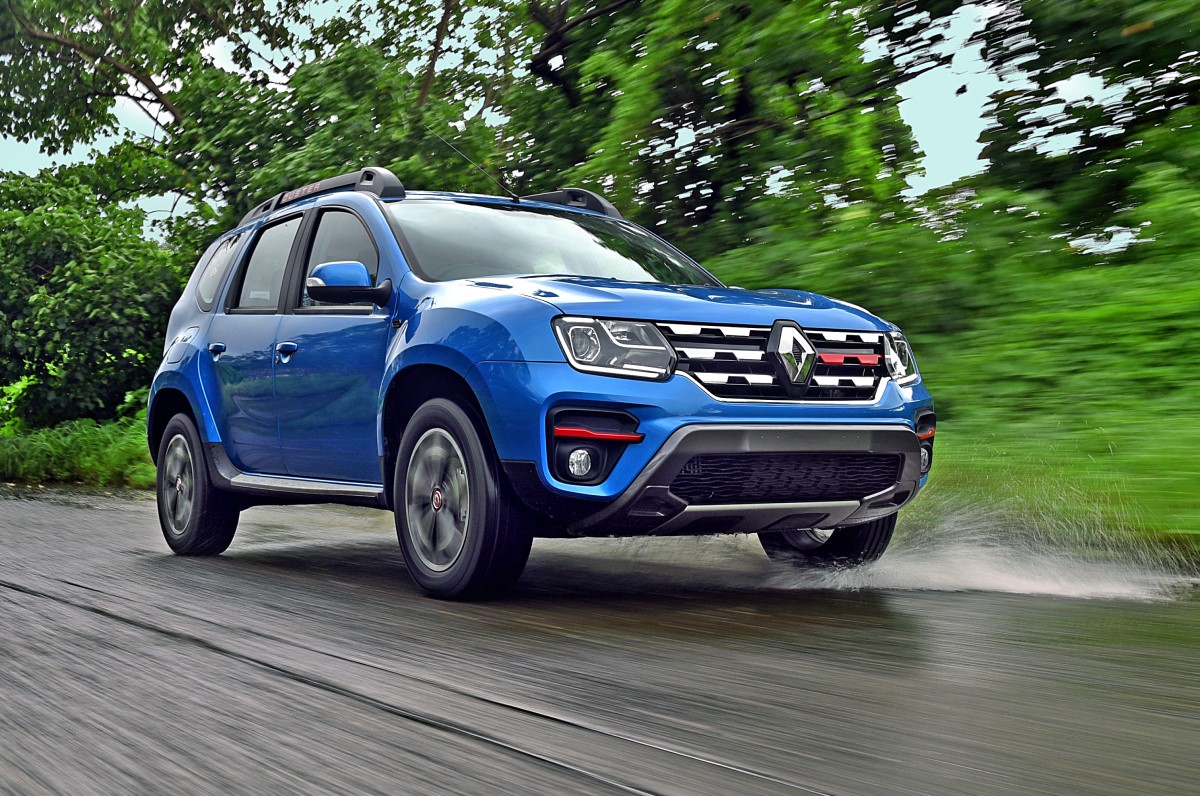
Renault gave the Duster a mid-life facelift in 2019 and this Turbo version carries forward the same styling. Unlike the Nissan Kicks Turbo, however, there are plenty of cosmetic bitsto distinguish the Turbo versionfrom its naturally aspirated (NA) petrol counterpart. There are splashes of red on the chrome grill, in the fog lamp housings and wheel centre caps, which instantly convey its sportier pretentions. The new, 17-inch ‘Forza’ diamond-cut wheels look stunning, especially when paired with this racy ‘Caspian Blue’ paint shade. The roof rails as well as the number plate applique get red Duster lettering, and while there isn’t much at the rear to speak of except a new ‘Turbo’ badge, for this update, Renault has ditched the quirky black tailgate vinylthat featured on the 2019 facelift.

Red highlights for the turbo version among the few cosmetic changes.

What is new inside the Duster Turbo’s cabin?

Changes to the interiors are even fewer than those on the outside. The notable addition here is the engine stop/start switch placed beside the front 12V power socket, and there is no Eco mode any more. The Duster’s interiors feel robust, the driving position is commanding, and the visibility all around is good. But when compared to its more modern rivals, the cabin feels a bit too rudimentary and lacks finesse. The touchscreen feels basic, the way in which the USB wire dangles when connected isn’t neat, and there is no place to securely stow your smartphone in the front. With inadequate storage areas and the lack of charging provisions, this cabin is now showing its age.

Interior feels a bit outdated compared to newer rivals.

Does the 2020 Duster Turbo get new features?

Apart from new 17-inch alloys, an engine stop/start function, and a new remote pre-cooling feature, the Duster’s equipment list is the same as the 2019 facelift; so it gets kit like automatic climate control, projector headlamps with LED DRLs, electric folding mirrors, cruise control, touchscreen with Android Auto and Apple CarPlay, reversing camera, cooled glovebox, driver armrest, ESP and hill-start assist, being the notable ones.


Equipment you’ll find on the competition that’s missing here, however, are things like automatic LED headlamps, an auto dimming inside mirror, rain-sensing wipers, a sunroof, rear AC vents, keyless entry and go, side and curtain airbags, cooled seats, rear disc brakes, and air purifier and wireless smartphone charging.

Should you buy the 2020 Duster Turbo?

So, the Duster Turbo isn’t the quickest around and that’s shame given its power credentials. However, it’s still a lot of fun and the performance is a massive step-up compared to the naturally aspirated petrol engine. In fact, this force-fed motor is strong, refined and feels zippy enough to occupy the middle ground between the NA petrol engine and the now-discontinued diesel engine.

Though Renault has spruced up the Turbo’s exteriors with red accents and sportier alloys to differentiate it from the NA petrol, the Duster’s interiors appear too dated, its equipment list is scant and it simply lacks the polish and sophistication of the Koreans. Also, when seen against its naturally aspirated sibling, which is available in the exact same trims, the roughly Rs 2 lakh premium for the Turbo is a lot, and the CVT automatic is even pricier, commanding a Rs 1.60 lakh premium over the manual.


However, turbo-petrols don’t come cheap, and looking at the Koreans, whose turbo-petrol ranges start Rs 2.50-3.50 lakh higher than the top-spec Duster Turbo, the Renault comes across as a value-for-money proposition. So, if you’ve always loved the Duster’s tough construction, its ability to tackle bad roads, and its solid fundamentals, then this one with the turbo engine is something to look forward to.

Also see:

Renault Duster 1.3 turbo-petrol launched at Rs 10.49 lakh

2020 Renault Triber AMT video review

Renault Kiger: What to expect


from Autocar India - Cars https://ift.tt/3jG30yV
Oppo F17 Series Launching in India at 7pm

Oppo F17 series which includes the Oppo F17 and the Oppo F17 Pro will be launched in India today, September 2 through a livestream. It will start at 7pm and will be hosted on all social media...

from NDTV Gadgets - Latest https://ift.tt/3hQfWkZ

Check out Samsung’s Galaxy Z Fold2 official introduction videos and photos

Earlier today, Samsung fully unveiled the Samsung Galaxy Z Fold2 including specs and pricing. Along with today’s announcement, Samsung also released a small lot of videos introducing the Galaxy Z Fold2. Along with the videos showing off the Z Fold2’s updated displays and hinge, a few lifestyle photos were released as well. The first video is Samsung’s cheeky farewell to “flat” referring to the current form-factor of all smartphones. “As one era ends the next one unfolds”. These lifestyle photos show some people modeling with the phone while not actually using it....


from GSMArena.com - Latest articles https://ift.tt/3hPJqzF